


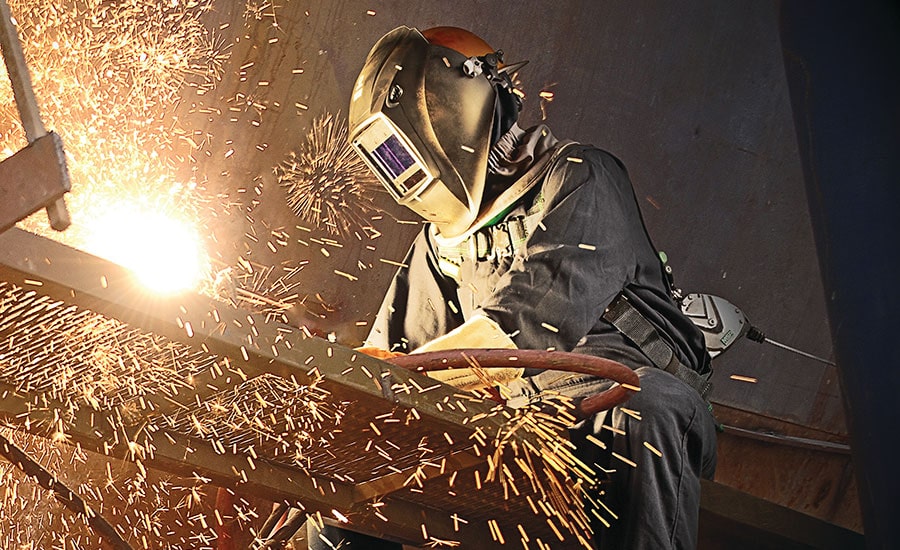
Causes of Excessive Spatter in CO₂ Welding
Welding with CO₂ shielding gas—known in industry as MIG/MAG welding or GMAW (Gas Metal Arc Welding)—is one of the most economical and widely used methods for joining metals in industries such as automotive manufacturing, steel structure construction, and metal fabrication.
However, every welder—whether beginner or professional—has faced a nightmare known as weld spatter. Excessive spatter means small and large droplets of molten metal that are thrown around like a shower of sparks, sticking to the workpiece surface, the torch nozzle, and even the welder’s clothing.
This phenomenon not only ruins the final appearance of the weld but also creates significant hidden costs. Hours wasted on grinding and cleaning, unnecessary consumption of welding wire, and accelerated wear of torch consumables are only part of the losses caused by excessive spatter.
The good news is that weld spatter is not a random event; it is a technical consequence that always has a specific cause.
In this comprehensive article, we dive deep into the welding process and examine more than 15 factors that cause spatter, along with practical solutions to eliminate it. If you want smooth, shiny, and trouble-free welds, keep reading.
The Nature of Spatter and the Physics of the Electric Arc
To solve the problem, we first need to understand what happens at the tip of the welding torch.
In CO₂ welding, metal transfer from the wire to the weld pool usually occurs in two ways:
Short Circuit Transfer:
The wire touches the workpiece, melts, and separates.
Globular Transfer:
Large droplets form and fall into the weld pool due to gravity.
Because of its molecular characteristics, CO₂ gas tends to push the transfer mode toward an unstable globular transfer. When gas flow or voltage settings are not properly adjusted, a repelling force forms beneath the molten droplet. Instead of guiding it into the weld pool, this force throws it outward.
In reality, spatter consists of small explosions caused by an imbalance between the wire melting speed and the droplet detachment force.
Main Causes of Excessive Spatter (Technical Analysis)
To make troubleshooting easier, we can divide the causes into electrical, mechanical, and chemical categories.
1. Incorrect Voltage and Amperage Settings (The Most Important Factor)
The relationship between voltage and wire feed speed (which determines amperage) must be precisely balanced.
Voltage Too Low:
If the voltage is lower than the wire feed speed requires, the wire hits the cold workpiece too quickly. This phenomenon, called stubbing, causes the wire to bounce against the weld pool like a spring, throwing molten metal droplets outward.
Voltage Too High:
High voltage increases the arc length. In CO₂ welding, a long arc becomes unstable, and molten droplets may explode in the air before reaching the weld pool, creating fine powder-like spatter.
2. Improper Stick-Out Length
Stick-out is the distance between the contact tip and the workpiece.
In CO₂ welding, this distance is critical.
If the stick-out becomes too long, the electrical resistance of the wire increases (Ohm’s Law). This preheating causes the wire to melt earlier than expected and detach explosively.
Standard Distance:
For short-circuit welding, it should be about 6–10 mm, and up to 15 mm for other modes. Longer distances almost guarantee excessive spatter.
3. Shielding Gas Type and Flow Rate
Gas Type:
Pure CO₂ gas is inexpensive and provides deep penetration but naturally produces more spatter. Using a gas mixture (for example 80% Argon + 20% CO₂) can reduce spatter by up to 90%, because argon stabilizes the arc and softens the metal transfer.
Gas Flow Rate:
Correct adjustment of the gas regulator (manometer) is essential.
Low flow rate: Air and nitrogen enter the weld pool, causing porosity and spatter.
High flow rate: Excessive gas pressure creates turbulence, which actually pulls air into the weld zone.
Typical recommended flow rate: 10–15 liters per minute, depending on nozzle size.
4. Contaminated Workpiece Surface
No advanced welding machine can perform well on dirty metal surfaces.
The following contaminants can cause explosions in the molten weld pool:
-
Oil, grease, and fats (release hydrogen)
-
Rust and oxides
-
Paint, primer, or galvanized coatings
-
Moisture on the metal surface
Solution:
Always clean the welding area using a grinder or wire brush until the metal becomes shiny before starting the weld.
5. Wire Feeding System Problems
If the welding wire feeds unevenly or intermittently, the arc repeatedly starts and stops.
Drive Roller Pressure:
If rollers are too tight, they deform the wire. If too loose, the wire slips.
Torch Liner:
If the liner inside the torch cable is dirty or twisted, the wire moves with friction, causing amperage fluctuations and spatter.
6. Torch Angle and Welder Technique
Excessive Angle:
If the torch is tilted more than 20 degrees, shielding gas escapes and air enters the arc.
The ideal angle is 5–15 degrees from vertical.
Push vs Pull Technique:
Push technique generally produces less spatter and shallower penetration.
Pull technique provides deeper penetration but slightly more spatter.
However, incorrect torch angles in either technique can cause severe welding defects.
7. Poor Ground Connection (Earth Clamp)
This factor is often overlooked.
If the ground clamp is attached to a rusty or painted surface, or if the ground cable is damaged, electrical current becomes unstable. Current fluctuation leads to arc instability and heavy spatter.
Advanced Technical Solution: The Role of Inductance
One of the key features in modern welding machines is the inductance adjustment.
But what exactly does inductance do?
In CO₂ welding, when the molten droplet touches the weld pool during short circuit transfer, the current suddenly rises to detach the droplet (Pinch Effect). If this current increase happens too quickly, the droplet explodes.
Inductance acts like a brake, controlling the speed at which current increases.
Higher Inductance:
-
Softer arc
-
Longer short-circuit duration
-
More fluid weld pool
-
Significantly reduced spatter
Lower Inductance:
-
Sharper, more concentrated arc
-
Higher penetration
-
More spatter
In older transformer welding machines, inductance was fixed. However, modern inverter welding machines allow welders to adjust arc softness and reduce spatter significantly.
Equipment and Consumables: Quality Matters
Sometimes all settings are correct, but the consumables are poor quality.
Low-Quality Welding Wire:
Wires with uneven diameter or weak copper coating disrupt electrical conductivity.
Nozzle and Gas Shroud:
If the contact tip hole becomes worn or oval-shaped, current transfer becomes unstable. Also, accumulated spatter inside the gas nozzle can block gas flow and create turbulence.
Using anti-spatter spray or paste is recommended to protect the nozzle.
Practical Troubleshooting Checklist
If you experience excessive spatter, follow these steps:
-
Listen to the arc sound
It should sound like a steady buzzing or frying egg. If you hear popping or explosions, adjust voltage and wire speed. -
Check stick-out distance
Keep it around 10 mm. -
Check the gas regulator
Ensure gas is flowing at 10–12 L/min. -
Check polarity
For solid wires, the torch should be connected to positive polarity (DCEP). Wrong polarity causes severe spatter. -
Check connections
Tighten the ground cable and ensure a clean connection surface. -
Inspect consumables
Clean or replace the contact tip and nozzle.
The Role of Welding Machine Technology
One of the most important factors in reducing spatter is the technology used in the welding machine itself.
Cheap and low-quality machines often cannot maintain a stable arc, and even with perfect settings they still produce spatter.
Modern inverter welding machines equipped with advanced arc control systems provide stable arcs and low-spatter welding performance, allowing welders to achieve very clean results—even when using pure CO₂ shielding gas

No comment